Vehicle Cyber Engineering Lab
As part of the Graduate Vehicle Cyber Engineering program at the University of Detroit Mercy, the VCE Lab gives master’s students hands-on experience with real industry problems and helps them build the skills, connections and credentials that make them stand out before they ever graduate.
What We Do at the Vehicle Cyber Engineering Lab

At the VCE Lab, faculty-led research goes beyond the classroom — targeting real industry problems and advancing thought leadership in automotive cybersecurity. With access to Car-in-a-Box, Truck-in-a-Box and other test beds, students gain hands-on experience detecting real-world automotive cyberattacks.
Students don’t just study the field, they contribute to it. Master’s students who lead experiments earn first-author credit on published technical papers, with faculty providing guidance and institutional credibility. As one student put it: “I’m not just doing homework, I’m publishing it.”
Recent publications from the lab include work on AI safety enhancements, cybersecurity rating frameworks and the development of Cybersecurity Labs as a Service (CLaaS). Explore the research: The Golden Tester · AI Safety Enhancements Based on ISO TR 5469 · Cybersecurity Rating Framework and Its Application to J1939-91C
More than academic exercises, students’ work in the lab equates to real contributions to the field, with their names as the bylines, enhancing their employment marketability upon graduation.
VCE Director Mark Zachos demonstrates a diagnostics gauge for U.S. Senator Gary Peters and former National Cyber Director Harry Coker Jr. as part of a VCE Lab testbed. Photo courtesy of University of Detroit Mercy
Why We Do It
Modern vehicles now make up more than just mechanical systems. They’re networked, software-driven and increasingly autonomous — and that makes them a target. As commercial and military fleets converge on shared infrastructure, the vulnerabilities in one become vulnerabilities in the other. The engineering community can’t afford to wait for the next generation of graduates to catch up. The work needs to happen now.
That’s why the VCE Lab exists. Traditional engineering education centers on theory first and application later, sometimes much later. We believe that model leaves students underprepared and the industry underserved. By embedding real research into the academic experience, we close that gap on both sides. Students graduate ready to contribute from Day One and the industry gains a steady pipeline of engineers who already understand the stakes.
The problems we work on are not hypothetical. They draw directly from the challenges facing automotive cybersecurity today — AI safety, network security standards, fleet vulnerability frameworks. When students publish research here, they do more than pad a resume. They actively contribute to a body of work that moves the field forward.
What You’ll Accomplish at the Vehicle Cyber Engineering Lab
Automotive cybersecurity sits at the intersection of electrical engineering, computer science and an industry that can’t find enough qualified people to do the work. UDM engineering instructor Mark Zachos created the VCE Lab in 2021 as part of the Graduate Vehicle Cyber Engineering program to close that gap. The program’s 15 credit hours are designed around the real technical demands of connected vehicle security.
Unlike a survey course, by the time you finish the program, you will know how to analyze threats, assess risk and build cybersecurity solutions for the embedded systems and networks that modern vehicles run on. Mark developed the lab’s curriculum in direct partnership with the automotive industry. So, what you learn on Tuesday remains relevant to what employers are hiring for on Wednesday.
The VCE Lab is where the real work happens. Students work on active research projects alongside faculty and fellow graduate students. You’ll contribute to published work and engage directly with industry partners pushing the field forward. More than an add-on to your education, for many, it becomes the defining part of it.

Day One-ready isn’t just a tagline. At the University of Detroit Mercy, it’s the standard.
Michigan’s No. 1 Private University for Engineering, according to US News – built to make students industry-ready before they graduate.
While others teach theory, UDM engineers are already working — earning up to $43,000 before graduation and hired before they leave.
REQUIREMENTS TO ENTER THE GRADUATE VCE PROGRAM
- Undergraduate GPA of at least 3.0 or equivalent
- Bachelor’s degree from an accredited university in Electrical Engineering, Robotics Engineering, Engineering with a relevant focus, Computer Science or a closely related STEM discipline.
- Applicants with cyber experience who do not meet the above will be required to complete prerequisites that do not count toward the degree as part of conditional admission.
REQUIREMENTS FOR SUCCESSFUL COMPLETION OF THE GRADUATE VCE PROGRAM
- Courses:
- CSSE 5545 Advanced Computer Security (3 credits)
- CSSE 5760 Network Security (3 credits)
- VCE 5110 Introduction to Cybersecurity (3 credits)
- VCE 5400 Secure Vehicle Embedded Systems (3 credits)
- VCE 5500 Secure Vehicle Electronics or ELEE 5500 Automotive Electronics (3 credits)
- Students must maintain at least a 3.0 GPA in both the certificate program and overall.
- Grades below a “C” will not advance a student toward graduation.
CURRENT PROGRAM
This semester, VCE Lab students are working at the cutting edge of automotive cybersecurity. Current projects center on SAE J1939-91C, the emerging standard for commercial vehicle network security, alongside research into secure on-board communication and vehicle diagnostic protection. This live, industry-relevant work happens in real time, with students contributing directly to research that shapes how the next generation of vehicles gets built and protected.
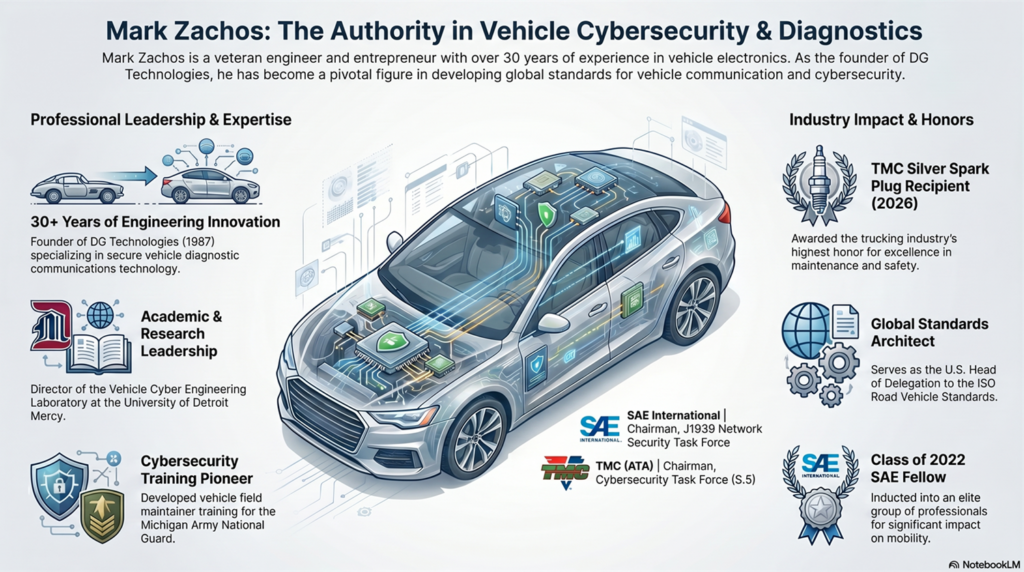
10 patents and four active SAE and ISO committees.