For as long as trucks have been on the road, cargo theft has been a problem: stolen trailers, pilfered loads, warehouse break-ins. But the game has changed and criminals are now pulling off cyber-enabled cargo theft to steal freight without ever touching a bolt cutter.
According to the U.S. Federal Bureau of Investigation (FBI), cargo theft losses in the United States and Canada spiked to nearly $725 million in 2025. That’s an increase of 60 percent from the year before. Cargo theft incidents rose by 18 percent. In an April 30 public service announcement (PSA) titled “Cyber-Enabled Strategic Cargo Theft Surging,” the agency reports that, per theft, the average value was $273,990, 36 percent higher than in 2024.
From emissions controls to electronic logging devices (ELDs), fleets and technicians repeatedly prove they can evolve with the times. But this current challenge is different. It’s fast-moving, invisible and increasingly profitable for criminals. It’s reshaping the risk landscape for every carrier, broker and fleet operator in North America.
Zero Trust
The day before the FBI published its PSA, the multi-agency Zero Trust Operational Technologies Security Working Group, led by the U.S. Cybersecurity and Infrastructure Security Agency (CISA), released a report titled “Adapting Zero Trust Principles to Operational Technology.” The 28-page publication provides practical guidance to industrial system operators on protecting physical machinery and operational networks using modern Zero Trust cybersecurity strategies. Zero Trust assumes that threats come from both outside and inside a network and that every request for access is a potential breach and should be verified.
Transportation systems are one example of operational technology (OT), which the report defines as, “A broad range of programmable systems and devices that interact with the physical environment or manage devices that interact with the physical environment. These systems and devices detect or cause a direct change through monitoring and/or control of devices, processes and events.”
It goes on to explain the need for Zero Trust. “With advancements in technology and networking, OT systems that were traditionally isolated or manually controlled are becoming increasingly interconnected, digitally monitored and remotely operated. This growing convergence between IT and OT expands the attack surface, introduces new attack vectors and magnifies cybersecurity risks.”
The two government publications paint a clear picture: trucking is a frontline target in a rapidly escalating cybercrime economy.
How the New Cyber-Enabled Theft Scheme Works
Blending cyber intrusion with physical theft, criminals are exploiting trust relationships across the supply chain and using compromised systems to, among many other things, redirect freight worth hundreds of thousands of dollars per load. For an industry built on tight margins, tight schedules and tight coordination, this shift is more than a technical problem for trucking. It’s a business-continuity threat.
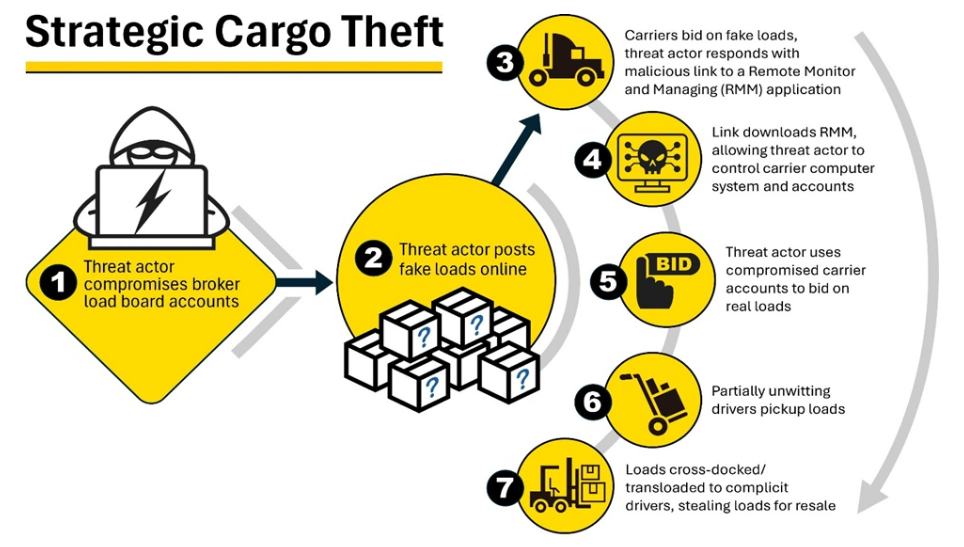
Source: U.S. Federal Bureau of Investigation Alert Number: 1-043026-PSA Cyber-Enabled Strategic Theft Surging, April 30, 2026
According to the FBI PSA, the attack process typically follows these steps:
- Compromise a broker or carrier account. Attackers impersonate a legitimate broker by sending emails with shortened, spoofed URLs, fake poor service-rating complaints or fraudulent carrier-broker agreements. Clicking links in the email sends the target to a legitimate-looking phishing website, which then installs remote monitoring and management (RMM) tools, giving criminals access to the victim’s systems.
- Use compromised broker accounts to post fake loads on trucking load boards. Criminals impersonate brokers and post fake loads. Legitimate carriers bid on them, unknowingly contacting attackers who then use links in malicious broker agreements to gain access to the carriers’ computer systems.
- Use compromised carrier accounts to bid on real loads. Criminals impersonate actual carriers, accept shipments, re-assign them to drivers who may or may not be aware of the scam and alter bills of lading, even updating FMCSA contact and insurance information to allow for unauthorized freight. Targeted carriers often only learn of the identity theft when brokers inquire about the missing loads.
- Divert and steal cargo. Stolen freight is transferred to co-conspirator drivers at intermediate facilities, who then re-route the shipments for resale.
- Demand ransom. Some bad actors then impersonate the carrier again and contact the original broker, demanding payment for the load’s location.
This sophisticated, multi-layered attack chain works because the industry relies heavily on trust, speed and digital coordination. And bad actors exploit all of it.
Why is Trucking So Vulnerable?
While the FBI highlights the immediate threat, the Zero Trust Operational Technologies report explains the deeper structural issue. Much of trucking’s digital infrastructure was not designed with adversaries in mind assuming identities, infiltrating systems and exploiting operational processes.
Fleets rely on load boards, telematics platforms, maintenance systems, dispatch software, ELDs, remote diagnostics, cloud-based platforms and more. And each connection is a potential attack surface. Criminals know that compromising one broker or carrier account can give them access not only to multiple platforms but ultimately to potentially thousands of loads.
The Zero Trust Operational Technologies publication emphasizes that OT environments, including industrial control systems, telematics and facility automation, often run on legacy hardware that cannot be easily patched, requires continuous uptime and has safety-critical functions. It’s not feasible to simply take a fleet offline to apply updates, nor can every telematics unit in a fleet necessarily be replaced overnight. And it’s hardly advisable to risk corrupting an ELD with an untested security patch.
Brokers trust carriers based on Federal Motor Carrier Safety Administration (FMCSA) data. Carriers trust brokers based on email and load board listings. Drivers trust dispatch instructions. And shippers trust paperwork. The industry depends on rapid decision-making in all of these areas, and bad actors are working to exploit this trust at every step.
Zero Trust Principles Relevant to Trucking
While the Zero Trust OT paper is aimed generally at industrial system operations, its principles apply directly to trucking. Not a product or a firewall, Zero Trust is a philosophy that, when understood, can help protect an organization: assume a breach has already occurred, trust nothing by default and verify everything. For trucking that may mean rethinking how fleets manage identity, access and system interactions.
Comprehensive asset visibility
You can’t protect what you can’t see. Fleets should have specific and comprehensive knowledge of which devices are connected, which software versions they run, who has access to what systems and which accounts are active or dormant. This includes telematics units, shop-floor diagnostics tools, tablets, dispatch laptops and even Wi-Fi-enabled shop equipment.
Strong identity and access management
Zero Trust requires strong identity and access management. This can include multi-factor authentication (MFA), role-based access controls, continuous monitoring of account behavior and immediate revocation of compromised credentials.
Network segmentation
OT systems, including telematics gateways, shop diagnostic equipment and facility automation, should not be on the same network as office email.
Secure communication protocols
To reduce the risk of spoofing and unauthorized access, encrypt and authenticate communication between trucks and dispatch, telematics devices and cloud platforms, shop tools and maintenance systems.
Proactive supply chain risk management
A compromised vendor can compromise your fleet. Zero Trust requires evaluating software supply chain risks, vendor access privileges, update and patching practices and third-party authentication standards.
Continuous monitoring and anomaly detection
Zero Trust assumes attackers are already inside the network. Detection must be behavior-based, integrated across IT and OT systems and in real-time. As the FBI PSA highlights, this is especially important for spotting unauthorized mailbox rules, spoofed domains or unusual load-board activity.
What Technicians Should Know and Fleet Owners and Managers Should Do
Trucking technicians are now part of the cybersecurity frontline and the systems they maintain – telematics units, diagnostic laptops, shop networks – are targets. A compromised shop laptop can be just as dangerous as a compromised broker account.
Technicians should:
- Verify the source of any software update or diagnostic tool download
- Avoid connecting shop equipment to unsecured Wi-Fi
- Report unusual device behavior immediately
- Ensure diagnostic laptops use MFA and updated antivirus tools
- Treat USB drives as potential attack vectors
Owners and managers should:
- Implement MFA across all systems
- Train staff to spot phishing and spoofed domains
- Audit all vendor access
- Segment networks
- Establish incident response plans
- Monitor FMCSA records for unauthorized changes
- Report incidents immediately at IC3.gov and to your local FBI field office
Cybersecurity – No Longer Just an IT Problem; Now an Operational Necessity
The FBI’s warning is unambiguous. Cyber-enabled cargo theft is surging and criminals are refining their methods. The Zero Trust OT guidance is equally clear: organizations must assume compromise and build layered defenses that protect both digital and physical operations. Trucking has always been resilient, and that resilience now requires a new skill set – one that blends operational expertise with cybersecurity discipline. The fleets that adapt will better protect their cargo, their reputation and their bottom lines. Those that don’t may find themselves part of next year’s statistics.
For more information and tips, read the FBI’s full PSA at: Internet Crime Complaint Center (IC3) | Cyber-Enabled Strategic Cargo Theft Surging
A version of this article first appeared in the Summer 2026 issue of the American Trucking Associations’ Technology & Maintenance Council’s Fleet Maintenance & Technology Magazine.